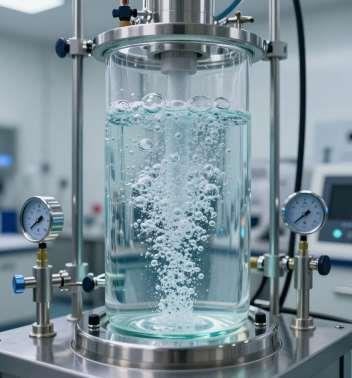
Fine gas bubbles speed up mass transfer; precise control gives stability and repeatability in laboratory and pilot flow processes.
Specifications
| Purpose | gas - liquid |
|---|---|
| Effect | increased phase contact area |
| Application | gas-liquid reactions |
Documents and quality
- Product certificate and operating manual
- Calibration certificate or factory test report (on request)
- Manufacturer's warranty card
- Delivery note and VAT invoice
Delivery terms
- Shipment from our warehouse in Vladivostok, delivery across Russia by freight carriers
- Payment by invoice (bank transfer) for legal entities and sole proprietors
- Delivery time and cost are agreed with the manager after the order is placed
Request a quote
The price depends on quantity, pack size, and delivery terms, so the manager quotes it for your specific case. A reply with the price and lead time usually arrives within one business day.
See also


Matched chemicals 6
-
Liquid chlorine
Why: Gas chlorination: microbubbles increase Cl₂ utilization
-
Caustic soda (sodium hydroxide)
Why: Hypochlorite production: Cl₂ + NaOH at a controlled temperature
-
Pd/C
Why: Slurry hydrogenation with H₂: gas-liquid mass transfer often limits the rate
-
Pt/C
Why: Hydrogenation of nitro compounds and oximes (reactions No. 23, 28 in the catalyst matrix)
-
2-(((4-Nitrophenyl)sulfonyl)oxy)ethyl isobutyrate
Why: Substrate for gas-liquid hydrogenation of the nitro group
-
Hydrogen peroxide 27.5%
Why: Oxidation that releases O₂, with control of the gas phase
Turnkey solutions: Microbubble Mixer
The selection is for guidance only; compatibility must be confirmed by a specialist.